
Friday, April 14, 2017


Saturday, April 8, 2017
Flag Raising on Iwo Jima by Joe Rosenthal 1945
This black and white photograph depicts six United States Soldiers raising a U.S. flag atop Mount Suribachi, during the Battle of Iwo Jima in World War II.

It is but a speck of an island 760 miles south of Tokyo, a
volcanic pile that blocked the Allies’ march toward Japan. The Americans needed
Iwo Jima as an air base, but the Japanese had dug in. U.S. troops landed on
February 19, 1945, beginning a month of fighting that claimed the lives of
6,800 Americans and 21,000 Japanese. On the fifth day of battle, the Marines
captured Mount Suribachi. An American flag was quickly raised, but a commander
called for a bigger one, in part to inspire his men and demoralize his
opponents. Associated Press photographer Joe Rosenthal lugged his bulky Speed
Graphic camera to the top, and as five Marines and a Navy corpsman prepared to
hoist the Stars and Stripes, Rosenthal stepped back to get a better frame—and
almost missed the shot. “The sky was overcast,” he later wrote of what has
become one of the most recognizable images of war. “The wind just whipped the
flag out over the heads of the group, and at their feet the disrupted terrain
and the broken stalks of the shrubbery exemplified the turbulence of war.” Two
days later Rosenthal’s photo was splashed on front pages across the U.S., where
it was quickly embraced as a symbol of unity in the long-fought war. The
picture, which earned Rosenthal a Pulitzer Prize, so resonated that it was made
into a postage stamp and cast as a 100-ton bronze memorial.
Mr. Rosenthal took this picture in order to memorialize this imagine in our minds, to never forget the sacrifices made and who was here to accomplish them. Even though he almost missed it, he did more with that one shot than he ever imagined. It showed me personally that the solders sacrifices were not in vain. It showed me bravery, honor and dedication to a common goal, this goal was to defeat the enemy and restore freedom and peace. Our Stars and Stripes had a specific meaning at that time, not just to Americans but, to others around the world. I felt that his photograph showed that meaning loud and clear. It is very emotional to sit back and really analyze the depth of this historical event. Even though it was way before my time, I can full understand with such respect and appreciation for all that was given to make it possible for me and us to be here today. No matter how many generations have been made since that time, this poignant time in history will never be forgotten or erased from our hearts and minds, EVER.
Mr. Rosenthal took this picture in order to memorialize this imagine in our minds, to never forget the sacrifices made and who was here to accomplish them. Even though he almost missed it, he did more with that one shot than he ever imagined. It showed me personally that the solders sacrifices were not in vain. It showed me bravery, honor and dedication to a common goal, this goal was to defeat the enemy and restore freedom and peace. Our Stars and Stripes had a specific meaning at that time, not just to Americans but, to others around the world. I felt that his photograph showed that meaning loud and clear. It is very emotional to sit back and really analyze the depth of this historical event. Even though it was way before my time, I can full understand with such respect and appreciation for all that was given to make it possible for me and us to be here today. No matter how many generations have been made since that time, this poignant time in history will never be forgotten or erased from our hearts and minds, EVER.
Saturday, April 1, 2017
God Bless America by Faith Ringgold (1964)

My Analysis of God Bless America
Today, she is known for her painted story quilts which by the name alone tells you that the art combines painting, storytelling, and quilted fabric of your choice. The painted story of "God Bless America" relates to the universal truths of the political and social issues that African-Americans have endured during that time period which personally she felt compelled to address. Faith Ringgold composed this piece by using oil paints on a 31 by 19-inch canvas. She uses line, shape, color, value and texture to depict the points she’s trying to make. The painting itself was painted during the Civil Rights movement in 1964 where white prejudice against African American was enforced by the legal system. The painting represents the imprisonment of the American Flag. The star on the flag symbolizes a sheriff's badge and the stripes on the flag symbolizes the bars of a jail cell.

Saturday, March 25, 2017
Existentialist: Part I & II
 Part I...
Freedom of choice, well there's no such thing as that, not really. Sure, you can chose to get up in the morning and make yourself breakfast, etc., but once you hit that door the outside world is not yours entirely. We have limited choice and we are like mice in a maze, looking for the cheese. We MUST have a purpose, that is what we call survival.
We are not given the choice to being born or even who our parents our. Although, I'm lucky on that cause I have a loving and supportive mother whom I love unconditionally. Most are not so lucky, which shakes me to the core. Yes, we are being taught by someone else and their ways, rules and laws. We can chose to abide by them or not but, there are consequences, and these consequences yet again are from someone else. I feel like there's a form or mold that ALL humans MUST be fit for. For example, your either far to the left or far to the right. There's never a happy medium for anyone, because it's just not natural in the eyes of the world. Hogwash, I say. Say, is all I can put out there for the moment, because I know sure as anything someone will challenge it. I'm speaking hogwash for myself, I control myself alone, on certain issues, etc. Everyone's different on certain things but, yes its true we are all molded one way to do one thing and that is to survive, however we do it, we ALL have to survive. Like I said about the maze, in that big scary place we call the world, you have the choice to live or die.
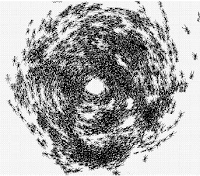
You can either be lead like cattle to slaughter with no place to go, except to the end of the line OR you can be like those suicide ants going around in a circle until someone places a finger in the middle to help you break free. The choice is yours.
.

Part II...
Now, I'm to Imagine??? Mmmm... I really don't have to imagine that existential hero. People have always had that perception about me anyways. Why? Maybe its because I don't have any friends, or maybe because I am quiet and sometime to myself. I just scope out the lay of the land sort of speak and little by little find my way out there. I'm just myself and being me. Sure things are not always easy but, it's working for me. I'm doing it the hard way for a reason and learning the experiences but, it will make for a harder shell to crack and I'm stronger because of that. It'll all come out good in the end, hard work will prevail they say and I believe that.

Sunday, March 12, 2017
Short Analysis of Advertising
(Puppy Love, Budweiser-2014 Super Bowl)
 I normally look forward to the ads during the Super Bowl. They are a mixture of all emotions and usually the things we really want to say/feel and the ads really do speak for themselves. The reason why I chose this ad specifically, one it's very touching and close to my heart. I love puppies! Also, I remember a time when I saw the Clydesdale's at Sea World, when they kept them there in the late 90's. They are amazing to see in person, such beautiful creatures. So this ad brought that to mind. Secondly, it made for a better Super Bowl Sunday watching this ad because this particular game was so boring and such a blowout, which made me lose interest very quickly. So, the ad more than made up the rather gloomy game, into a joyous ending. As you watch the ad from the link provided you will understand completely my meaning for which I have explained.
 I normally look forward to the ads during the Super Bowl. They are a mixture of all emotions and usually the things we really want to say/feel and the ads really do speak for themselves. The reason why I chose this ad specifically, one it's very touching and close to my heart. I love puppies! Also, I remember a time when I saw the Clydesdale's at Sea World, when they kept them there in the late 90's. They are amazing to see in person, such beautiful creatures. So this ad brought that to mind. Secondly, it made for a better Super Bowl Sunday watching this ad because this particular game was so boring and such a blowout, which made me lose interest very quickly. So, the ad more than made up the rather gloomy game, into a joyous ending. As you watch the ad from the link provided you will understand completely my meaning for which I have explained.
Budweiser's heartwarming 2014 Super Bowl commercial (in which a puppy befriends a horse) has been ranked the most popular ad ever to air in the 50-year history of the NFL's premier event, according to a study from TiVo. That's largely because the company took the time to develop a plot line. The beer company's 90-second "Puppy Love" commercial does more than depict the friendship between two (adorable) furry animals. As the puppy repeatedly attempts to escape the kennel and find the Clydesdale, a relationship also develops between the kennel owner and the horse-keeper. The ad culminates when horses bar the puppy from leaving in a car, and the humans consent to let them play together in peace.
Friday, March 3, 2017
A Farewell to Arms
by Ernest Hemingway

ABOUT THE BOOK
A Farewell to Arms is a novel by Ernest Hemingway set during the
Italian campaign of World War I. The book, published in 1929, is a first-person
account of American Frederic Henry, serving as a Lieutenant
("Tenente") in the ambulance corps of the Italian Army. The title is
taken from a poem by 16th-century English dramatist George Peele. A Farewell to
Arms is about a love affair between the expatriate American Henry and Catherine
Barkley against the backdrop of the First World War, cynical soldiers, fighting
and the displacement of populations. The publication of A Farewell to Arms
cemented Hemingway's stature as a modern American writer, this became his first
best-seller and is described by biographer Michael Reynolds as "the
premier American war novel from that debacle World War I.
THEMES PERTAINING TO THE BOOK
THE GRIM
REALITY OF WAR
As the title of the novel makes clear, A Goodbye to Arms concerns
itself mostly with war, namely the process by which Frederic Henry removes
himself from it and leaves it behind. The novel offers excellently-done
descriptions of the conflicts and confusion: the scene of the Italian army's
retreat remains one of the most deeply extreme memories of war in American
books. Henry's shooting of the engineer for refusing to help free the car from
the mud shocks: first, the violent outburst seems fighting with Henry's coolly
detached character; second, the event happens in a setting that robs it of its
moral import--the involvement with the crime of Henry's fellow soldiers justify
the killing. Anyway, the novel cannot be said to strongly criticize the war;
Instead, the innocent engineer's death is the unavoidable result of the cruelty
of war. Hemingway hints that war is nothing more than the dark, murderous
extension of a world that refuses to admit to, protect, or preserve true love.
THE
RELATIONSHIP BETWEEN LOVE AND PAIN
Against the background of war, Hemingway offers a sadly deep thinking
about the nature of love. No sooner does Catherine announce to Henry that she
is in suffering for her dead fiancé than she begins a game meant to flirt with
Henry. Also, Henry intends to get as far away from talk of the war as possible.
In each other, Henry and Catherine find comfort from the things that badly
bother them. Henry's understanding of how meaningful his love for Catherine is
outweighs any forethought for the emptiness of fuzzy ideals such as honor,
enabling him to run from the war and look for her. Reunited, they plan a
peaceful life together that promises to act as a skin medicine for the damage
that the war has caused. The terrible event of the novel rests in the fact that
their love, can never be more than temporary in this world.
MASCULINITY
Readers of Hemingway's fiction will quickly see a consistent thread in
the representation and celebration of a certain kind of man: bossy, extremely
extraordinary and proud. Rinaldi is a faithful friend and an oversexed man, who
loves to flirt with women; Dr. Valentini shows a masculinity to rival Rinaldi's
as well as a bold smart ability that makes him the best doctor. During the
scene in which Henry fires his pistol at the running engineering sergeants,
Bonello takes charge of the situation by harshly shooting the fallen engineer
in the head. The respect with which Hemingway sketches these men, even at their
lowest points, is highlighted by the humor, if not contempt, with which he
shows their opposites.
GAMES AND
DIVERTISEMENT
Henry and Catherine begin flirting with each other to forget personal
troubles. Flirting, which Henry compares to bridge, allows Henry to "drop
the war" and focus on something else like Catherine's thoughts from the
death of her fiancé. Also, the horse races that Catherine and Henry attend
enable them to block out thinking of Henry's return to the front and of their
happening soon separation. Henry and Catherine's relationship becomes the
source of suffering from which Henry needs diversion. Henry cannot stand to be
away from Catherine, and while playing pool with Count Greffi takes his mind
off of her, the best entertainment turns out to be the war itself. When
Catherine instructs him not to think about her when they are apart, Henry
replies, "That's how I worked it at the front”. The changes of the war
from deadly threat into entertainment and love tampers not only Henry's
attachment to Catherine but, also the short-lived nature of happiness.
LOYALTY
VERSUS ABANDONMENT
The ideas of loyalty and being alone apply equally well to love and
war. Then overall, however, hints that loyalty is more a needed thing of love
and friendship than of the grand political causes and ideas of fighting
nations. Although he shoots an uncooperative engineering sergeant for failing
to obey his orders, Henry's violence should be read as an unavoidable result of
a destructive war rather than as a serious and well-thought-out decision to
enforce a code of moral behavior. While he does, at times, feel guilt over this
course of action, he takes comfort in the knowledge that he is most loyal where
loyalty counts most: in his relationship with Catherine. That these disagreeing
loyalties cannot be reached does not suggest, however, that loyalty and being
left alone lie at opposite ends of a moral spectrum.
ILLUSIONS
AND FANTASIES
 Upon meeting, Catherine and Henry rely upon a grand fake image of love
and leading someone away from what's right, usually for sex for comfort. At
first, their love is clear and honest: Catherine reminds Henry at times that
their early stages of the relationship are a game, sending him away when she
has played her fill. After Henry is wounded, however, his desire for Catherine
and the comfort and support that she offers becomes more than an object or
action from the world's unpleasantness. While the couple acts in ways that
confirm the honest nature of their passion, however, they never escape the
desire of dreaming of a better world. Boredom has begun to set in, and the
couple effects small daily changes to give new life to their lives and their
passion: Catherine gets a new haircut, while Henry grows a beard. They dream of
life on a Swiss mountain, where they will make their own clothes and need
nothing but each other, suggesting that fantasizing is part of successfully
dealing with the dull, sometimes damaging effects of reality.
Upon meeting, Catherine and Henry rely upon a grand fake image of love
and leading someone away from what's right, usually for sex for comfort. At
first, their love is clear and honest: Catherine reminds Henry at times that
their early stages of the relationship are a game, sending him away when she
has played her fill. After Henry is wounded, however, his desire for Catherine
and the comfort and support that she offers becomes more than an object or
action from the world's unpleasantness. While the couple acts in ways that
confirm the honest nature of their passion, however, they never escape the
desire of dreaming of a better world. Boredom has begun to set in, and the
couple effects small daily changes to give new life to their lives and their
passion: Catherine gets a new haircut, while Henry grows a beard. They dream of
life on a Swiss mountain, where they will make their own clothes and need
nothing but each other, suggesting that fantasizing is part of successfully
dealing with the dull, sometimes damaging effects of reality.
BANNED,
CENSORED OR CHALLENGED
- Challenged in NY
(Vernon-Verona-Sherill School District) as a “sex novel.” (1980) and in
Texas (Dallas Independent School District) (1974). Also, challenged in
1987 at the Baptist College in Charleston, SC due to “language and
sexual references in the book.”
- Banned in
Italy (1929) apparently due to the description of the retreat from
Caporetto. Also, banned in Ireland (1939) and in Boston (1929) for
politics, sex, and language.
- Burned in
Germany (1933) …by Nazis. For “being a monument of modern
decadence.”
PERSONAL
REFLECTION
In high school, I saw the movie with Gary Cooper and you know how the
movie is always different from the book. I decided to read the book to look for
any differences. Naturally the language
and sex themes, which in the movie, was toned down because of the viewing audience
at the time. I liked the movie because it suited my tastes, considering that
time frame (1930’s).
WORK CITED
"A Farewell to Arms." SparkNotes. SparkNotes, n.d. Web. 03 Mar. 2017.
"Banned Book Club: A Farewell to Arms." Graphing Wonderland. N.p., 01 July 2013. Web. 03 Mar. 2017
Harris, Heather. "Ernest Hemingway." Ernest Hemingway. N.p., 01 Jan. 1970. Web. 03 Mar. 2017.
Friday, February 24, 2017
Death of the Ball Turret Gunner

The Death of the Ball Turret
Gunner is a five-line poem by Randall Jarrell published in 1945. It is about
the death of a gunner in a Sperry ball turret on a World War II American bomber
aircraft.
From my mother's sleep I fell
into the State,
And I hunched in its belly till my wet fur froze.
Six miles from earth, loosed from its dream of life,
I woke to black flak and the nightmare fighters.
When I died they washed me out of the turret with a hose.
Jarrell, published the poem
in 1945. It drew directly from his own involvement with military aircraft and
airmen during WW2. he provided the following explanatory note: A ball
turret was a Plexiglas sphere set into the belly of
a B-17 or B-24, and inhabited by two .50 caliber machine guns
and one man, a short small man. When this gunner tracked with his machine guns
a fighter attacking his bomber from below, he revolved with the turret; hunched
upside-down in his little sphere, he looked like the fetus in the womb. The
fighters which attacked him were armed with cannon firing explosive shells. The
hose was a steam hose. The theme of Randall Jarrell's "The Death of
the Ball Turret Gunner" is that institutionalized violence, or war,
creates moral paradox, a condition in which acts repugnant to human nature
become appropriate. Most commentators agree, calling the poem a
condemnation of the dehumanizing powers of "the State", which are most
graphically exhibited by the violence of war. This poem made me feel like I was
there. What I mean by that is, by reading this and from a personal family
experience, I understand it all now. My Great Uncle was a ball turret gunner
during WWII in the European theater. He had many demons over the years from
that experience. He didn't want to talk about it, he drank to numb the pain and
it sadly took a good man down. Also, when
I read the poem it made me very sad, especially when he said "When I died
they washed me out of the turret with a hose".

The Death of the Ball Turret
Gunner is a five-line poem by Randall Jarrell published in 1945. It is about
the death of a gunner in a Sperry ball turret on a World War II American bomber
aircraft.
And I hunched in its belly till my wet fur froze.
Six miles from earth, loosed from its dream of life,
I woke to black flak and the nightmare fighters.
When I died they washed me out of the turret with a hose.

Jarrell, published the poem
in 1945. It drew directly from his own involvement with military aircraft and
airmen during WW2. he provided the following explanatory note: A ball
turret was a Plexiglas sphere set into the belly of
a B-17 or B-24, and inhabited by two .50 caliber machine guns
and one man, a short small man. When this gunner tracked with his machine guns
a fighter attacking his bomber from below, he revolved with the turret; hunched
upside-down in his little sphere, he looked like the fetus in the womb. The
fighters which attacked him were armed with cannon firing explosive shells. The
hose was a steam hose. The theme of Randall Jarrell's "The Death of
the Ball Turret Gunner" is that institutionalized violence, or war,
creates moral paradox, a condition in which acts repugnant to human nature
become appropriate. Most commentators agree, calling the poem a
condemnation of the dehumanizing powers of "the State", which are most
graphically exhibited by the violence of war. This poem made me feel like I was
there. What I mean by that is, by reading this and from a personal family
experience, I understand it all now. My Great Uncle was a ball turret gunner
during WWII in the European theater. He had many demons over the years from
that experience. He didn't want to talk about it, he drank to numb the pain and
it sadly took a good man down. Also, when
I read the poem it made me very sad, especially when he said "When I died
they washed me out of the turret with a hose".


https://www.poemhunter.com/poem/the-death-of-the-ball-turret-gunner-2
Subscribe to:
Posts (Atom)